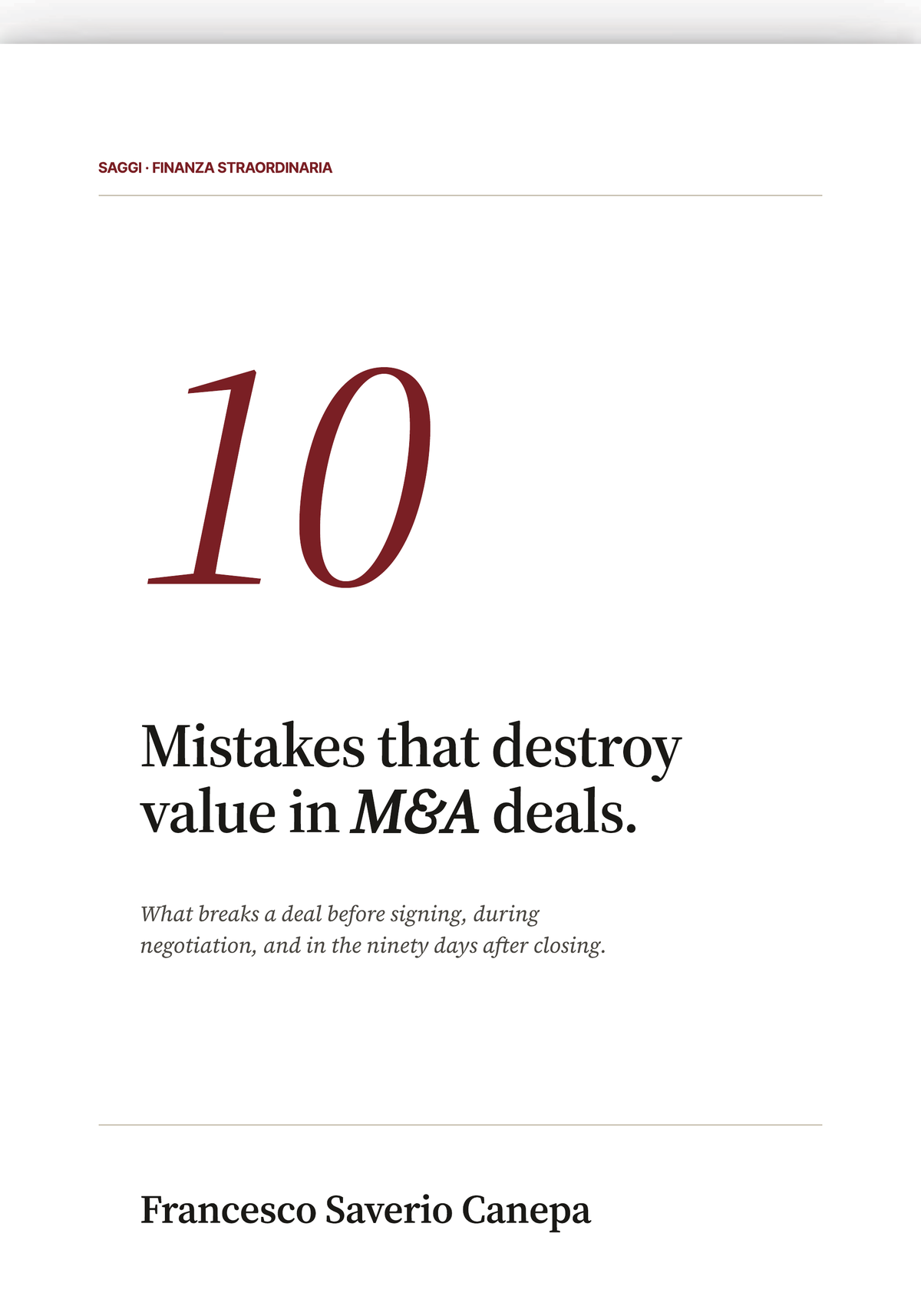
What breaks a deal before signing, during negotiation, and in the ninety days after closing.
One hundred and ninety pages, ten standalone chapters, three operational checklists. Real cases commented — MPS-Antonveneta, ITA-Lufthansa, Yoox-Richemont, ION-Prelios, TIM-KKR, Indesit-Whirlpool — plus two anonymized composite cases for reasons of professional confidentiality.
M&A textbooks already exist, often excellent, and are almost always written by academics, practitioners from large international law firms, or Anglo-Saxon investment banks. This book does not aim to compete with those texts. It aims to do something else: to describe where, in real practice, the M&A process actually breaks.
The volume is not meant to be read in sequence. It should be consulted by chapter, depending on the moment in the process. Chapter 1 is useful before opening a mandate; Chapters 2, 4, 5 and 8 during the negotiation phase; Chapter 6 for those building the funding stack; Chapters 7 and 9 after signing. Chapter 3 should be read twice. Chapter 10 is the premise of all the others.
— From the Preface
From before the mandate to ninety days after closing.
The mistake that precedes all others: the deal has a direction, but lacks a thesis.
The EV/EBITDA trap: what you actually buy, and what it costs to align it later.
People, incentives, decision-making patterns — the side Anglo-Saxon frameworks don't look at.
Whoever drafts first negotiates from a position of strength — always. How not to lose it.
The mechanism meant to reduce conflict, and almost always amplifies it in the next twenty-four months.
Bridge, mezzanine, cov-lite — where Italian structures break when the market tightens.
Management, banks, key clients, regulators — who to inform, in what order, with what words.
Key contracts, financings, joint ventures — what triggers automatically on the day of closing.
The first ninety days decide seventy per cent of the value created — or destroyed — in the entire deal.
The mistake that amplifies the other nine. A selection scorecard, written by someone on the other side of the table.
If you are preparing an M&A deal, or have one stalled, we can talk directly. No questionnaire, no aggressive discovery: thirty minutes to see if it makes sense to work together.
Book the conversation