


Research
Original work on decision quality, board judgment and adversarial artificial intelligence. Open, pre-registered and verifiable methodology.

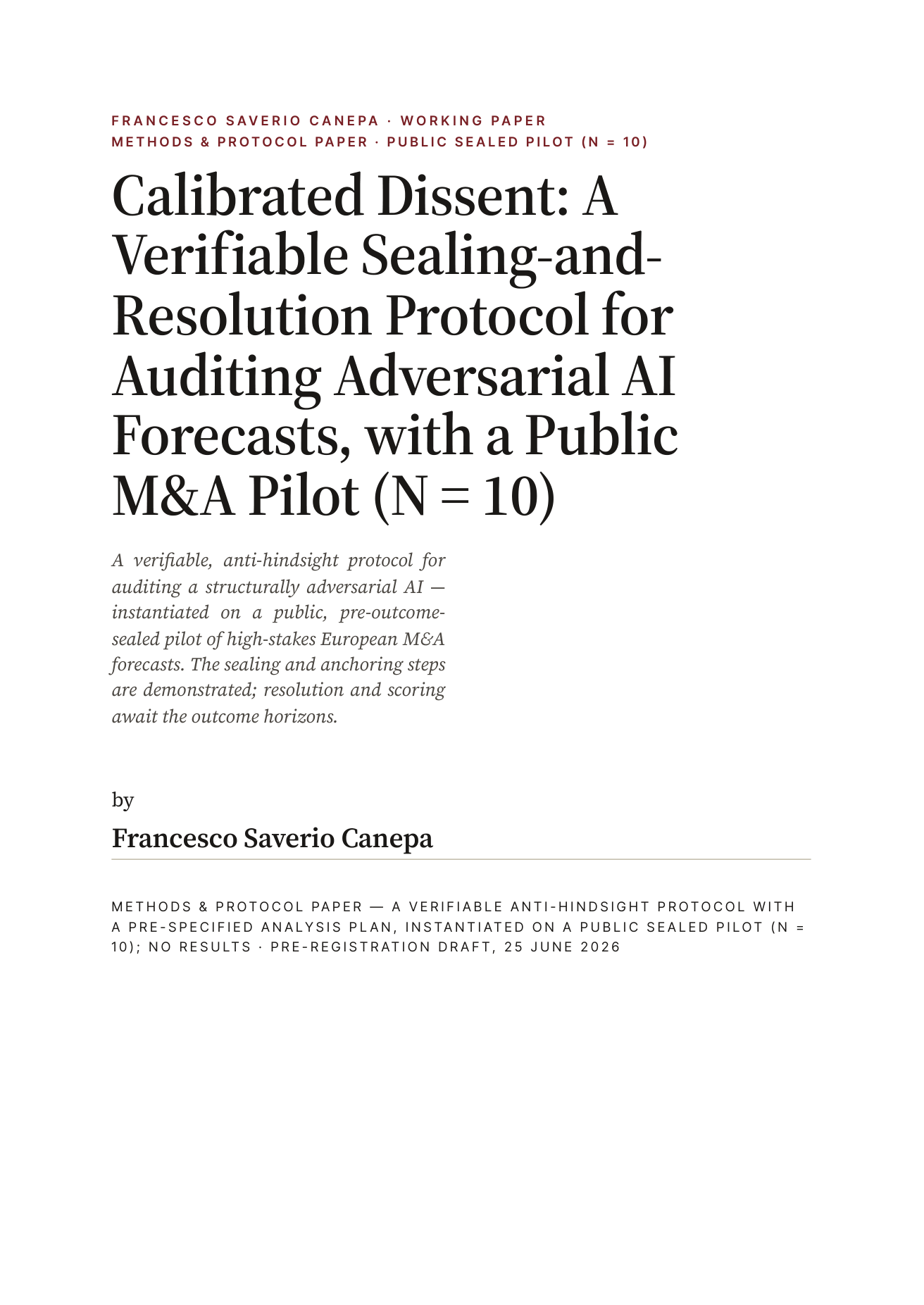
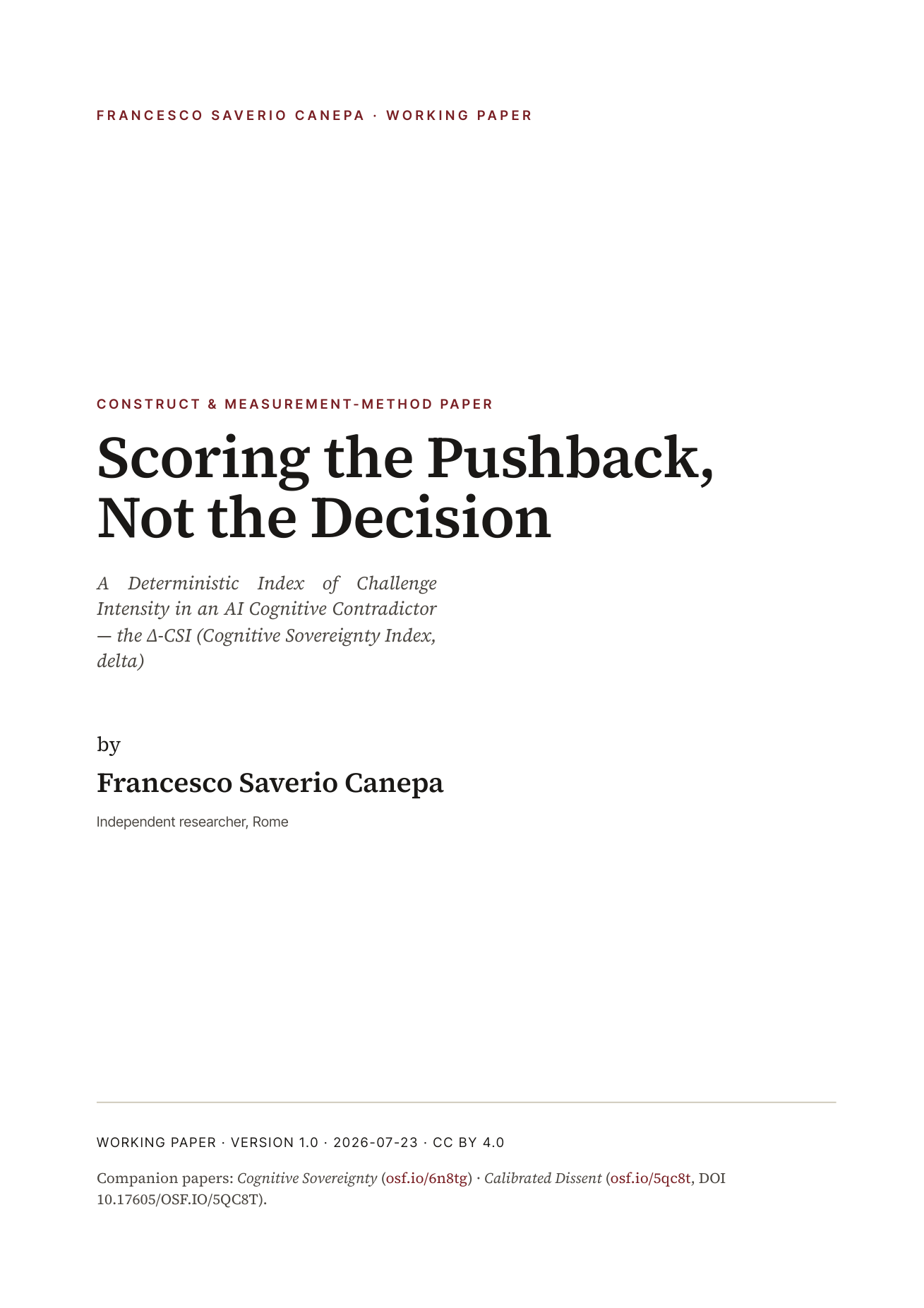

The three papers are companions: the first grounds the concept, the second builds the protocol that puts it to the test, the third defines the unit in which the challenge is measured. The essay carries them outside academia.
Why a research section
This section collects Francesco Saverio Canepa’s original research on a question that professional practice makes more urgent by the day: what happens to the quality of judgment — of a board, an investment committee, an advisor — when analysis is intensively assisted by artificial intelligence. Twenty years of extraordinary-finance transactions teach that the worst decisions rarely come from a lack of analysis: they come from analysis that confirms what one wanted to hear.
The three papers approach the problem from complementary directions. Cognitive Sovereignty defines the construct and the governance framework: what must be protected, and by which principles. Calibrated Dissent builds the verification instrument: a protocol to establish, without hindsight, whether an AI designed to challenge decisions dissents accurately. Scoring the Pushback pins down the quantity the first two presuppose: how much challenge intensity was actually applied to a single decision.
Method: open, pre-registered, verifiable
The research follows three methodological commitments. Pre-registration: the Calibrated Dissent protocol is registered on OSF with a public DOI before any outcome is observable. Verifiability: every pilot forecast is sealed in a public, append-only ledger — the Observatory — with a double anchor, SHA-256 and OpenTimestamps on the Bitcoin blockchain: anyone can independently verify that the published content existed before a given date. Falsifiability: resolution rules are deterministic, defined over canonical public sources and compared against pre-registered baselines.
What this research does NOT claim
The public N = 10 pilot illustrates the protocol; it does not prove its efficacy — it is explicitly non-evidence. The Δ-CSI measures the intensity of the challenge, never the correctness of the decision, and makes no claim of empirical validity. Confirmatory claims belong to a powered Phase 2, whose analysis plan is pre-registered.
Trajectory
The outcomes of the ten pilot forecasts mature over 2027–2029 windows and will be resolved under the deposited rules. In parallel, Phase 2 will extend the sample beyond the statistical power threshold required for the first confirmatory tests. Updates and full materials remain accessible from the individual paper pages and the OSF project.
Follow the research
OSF project, public ledger and reference implementation.
