

Updated on
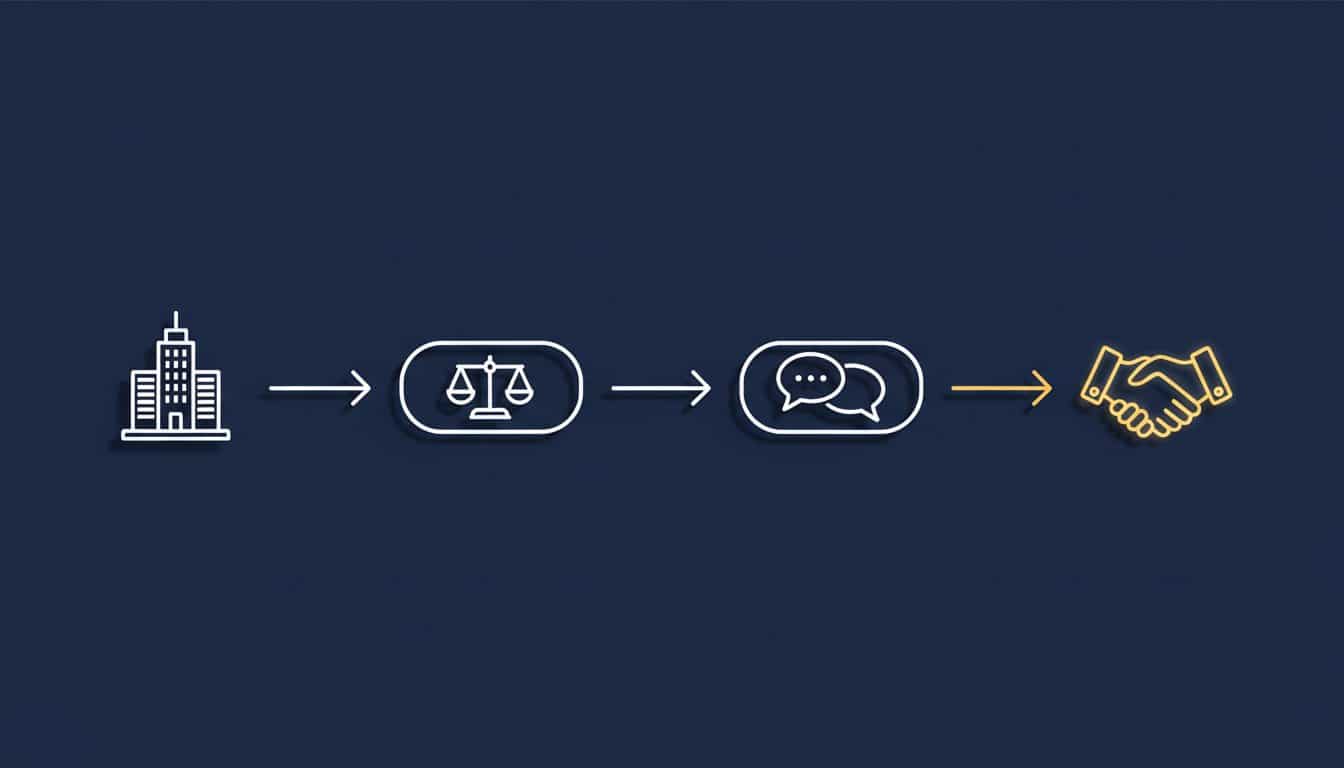
How to sell a business: in brief. Selling a commercial business takes four phases: preparation (putting accounts, contracts and stock in order), a realistic valuation, identifying potential buyers, and negotiating through to closing. Working with an independent adviser helps maximise the price and manage the risks typical of the negotiation.
Deciding to sell the business you built over years of dedication is one of the most significant and complex moments in an entrepreneur’s life. Crucial questions arise inevitably: how do I establish the right value so as not to undersell? Which legal and tax steps must not be underestimated? And how do I manage the whole process while maintaining discretion?
Taking on the challenge of selling a commercial business without a strategic view can compromise the final result. This is a complete guide, updated for 2026. It sets out the full process for orchestrating a successful sale: from the valuation that maximises the price, to finding the ideal buyer, through to closing without surprises. The aim is to give you an expert’s tools to capitalise properly on your work and move calmly to the next phase of your life.

Phase 1: Strategic Preparation — The Foundations of Success
The decision to sell a commercial business is among the most complex and significant an entrepreneur takes. It is not a simple transaction but a strategic operation which, managed with method and foresight, can maximise the economic and personal value of a life’s work. The preparation phase is without doubt the most critical: laying solid foundations means creating the conditions for an advantageous negotiation and a smooth sale.
A professional approach requires looking at the company no longer through the owner’s eyes but through an investor’s. That change of perspective is essential to identifying and building on the strengths, mitigating the weaknesses and presenting an investment opportunity that is clear, credible and attractive. Discretion, at this initial stage, is a crucial asset to protect — you do not want to alarm employees, customers and suppliers.
Preliminary Analysis: Why Are You Selling?
Before any concrete action, an honest self-examination is fundamental. The motives for selling — retirement, a change of life, the desire to pursue new ventures — directly influence the negotiating strategy. A seller with no urgent need for liquidity can handle the negotiation with greater bargaining power. Defining a realistic timeline for the whole divestment process is the first step towards keeping control.
The three windows: when it is the right time to sell
The Italian mid-market is one of Europe’s most active, with 1,080 transactions recorded in 2025. Within it, timing moves price more than almost any other lever, and it opens in three recognisable windows.
- Window 1 — structural growth peak. Three to four consecutive years of EBITDA growth at or above 15%, with an order backlog of six months or more. This is where premium multiples appear, 15-25% above market.
- Window 2 — sector consolidation in motion. When buyers are competing for position rather than assets, the scarcity works for the seller.
- Window 3 — founder structural change. The one to anticipate: selling under pressure costs a 20-30% discount. The window should be opened 12-18 months before the need becomes visible.
Sector matters as much as timing. Italian medical devices, for example, saw 47 transactions across 2024-2025 with EV/EBITDA multiples moving from 6.5x to 9.2x — the same business sold at either end of that range is a materially different outcome.
Making the Business ‘Sale-Ready’
A sale-ready business is one that is optimised, transparent and with legal and operational risks reduced to a minimum. The objective is to make it as independent as possible from the figure of the entrepreneur, demonstrating that its profits are sustainable over time. The key actions include:
- Contract review: Making sure lease agreements, licences, arrangements with strategic suppliers and employment contracts are in order, valid and, where possible, transferable.
- Resolving disputes: Settling any ongoing legal, tax or administrative dispute. Unresolved litigation is a serious red flag for a buyer.
- Asset inventory: Creating a detailed list of all tangible assets (equipment, property, stock) and intangible ones (trademarks, patents, goodwill, customer base) that will be included in the sale.
The Importance of Organised Documentation
Transparency is a synonym for credibility. A complete and well-organised information pack is the best calling card for a serious buyer. It not only accelerates due diligence but reinforces the perceived value of the business. It is imperative to gather and order accounts and tax returns for the last three to five years, valid licences and permits, and every other document attesting to the health and compliance of the business. Impeccable documentation is a strategic asset.
Phase 2: Establishing the Right Price — Valuing the Business
Determining the sale price is unquestionably the most critical and delicate step of the whole process. The wrong figure, whether too high or too low, can undo months of preparation and drive away qualified buyers. The most common error is yielding to an emotional estimate, tied to the years of work and sacrifice invested. To sell a commercial business successfully, it is imperative to adopt an analytical and objective approach founded on recognised valuation methodologies.
The Main Valuation Methods
There is no single formula for calculating what a company is worth; the most accurate estimate often comes from combining different approaches. The choice depends on the nature of the business, the sector and the type of assets. The most widely used are:
- Multiples method: Applies a multiplier to a key economic indicator, such as EBITDA or turnover. It is a market-based approach that works wherever comparable transactions exist, and it is the reference method in the Italian mid-market.
- Asset-based method: Calculates the market value of all company assets (property, machinery, stock) net of liabilities and debt. It provides the tangible value of the business, often treated as a starting point.
- Income method: Focuses on the company’s future ability to generate profit or cash flow. This forward-looking method is ideal for businesses with stable and predictable profitability.
What Goodwill Is and How It Affects Value
Beyond the tangible value of the assets, a fundamental component of the price is goodwill. The concept represents the intangible capital the business has built: the strength of the brand, customer loyalty, a strategic location, established supplier relationships and accumulated know-how. Quantifying goodwill correctly is complex and requires experience, since it is precisely this asset that justifies a sale price above the mere book value of the assets.
Critical Factors and Mistakes to Avoid
The final price depends not only on the accounts but on external factors such as market conditions, and internal ones such as operational dependence on the entrepreneur. Ignoring that context leads to strategic errors that can invalidate the negotiation. The most common include:
- Overestimating value on the basis of emotional attachment and the work put in.
- Ignoring market conditions and the prices of recent comparable transactions.
- Not accounting for debt and liabilities when calculating the final value to shareholders (equity value).
Relying on a professional and independent valuation is not a cost but a strategic investment. It provides a solid and defensible negotiating base, increases credibility with potential buyers and maximises the odds of closing at the best possible price.
Phase 3: The Sale Process — Finding the Buyer and Negotiating
Once the valuation is complete and the documentation prepared, the process begins in earnest. This phase requires a methodical and strategic approach in which discretion matters as much as proactivity. The objective is not simply to find a buyer but to identify the right buyer — one able to recognise the intrinsic value of the business and to see the transaction through seriously.
Creating an Effective Sale Profile
Presenting your business has to follow a structured path in order to protect confidentiality. It starts with a blind profile (or teaser): an anonymous one- or two-page document describing the investment opportunity — sector, indicative size, strengths — without revealing the company’s name. That instrument is fundamental for testing market interest. Only those who express concrete interest and sign a non-disclosure agreement receive the Information Memorandum: the actual sale dossier, setting out in detail the history, market analysis, historical and forecast financials, and future growth opportunities.
Finding the Ideal Buyer
Success in selling a commercial business often depends on the quality of the contacts, not their quantity. The most effective channels are rarely public listings. It is essential to activate a professional network — accountants, corporate lawyers, consultants and advisers — who may have access to a portfolio of qualified potential investors. These can be:
- Strategic buyers: competitors, suppliers or customers seeking operational and market synergies.
- Financial buyers: private equity funds or private investors interested primarily in the return on investment.
Before sharing any sensitive information contained in the Information Memorandum, it is mandatory to have the counterparty sign a Non-Disclosure Agreement, a legal document binding them to complete confidentiality.
How buyers see you: industrial versus financial
The two buyer types do not value the same things, and a process that treats them identically leaves money behind. An industrial buyer pays for synergies — access to your customers, your plant, your licences — and tends to move faster where the strategic fit is obvious. A financial buyer, typically a private equity fund, pays for a business that can run without you, and will price founder dependency ruthlessly.
A third category is worth naming because it is systematically underestimated: the cross-border buyer. Statistically, foreign acquirers pay 12-18% higher multiples than an Italian buyer for assets of equivalent quality — and reaching them is precisely what a domestic-only process does not do.
The Negotiation
Once a seriously interested buyer is identified, the negotiation opens. It is crucial to have defined in advance not only an asking price but a minimum acceptable threshold below which you are not prepared to go. Be prepared to handle objections, requests for clarification and proposals to revise the price. The negotiation is not only about economic value but about the accompanying conditions: payment timing, the guarantees required (representations and warranties) and the seller’s potential involvement in the transition. Managing these dynamics is a complex art. Let’s discuss it in a confidential 30-minute call
Phase 4: From Due Diligence to Closing — The Final Stages
Once a buyer is identified and a price agreed in principle, the process of selling a commercial business enters its most technical and delicate phase. This is where the strength of the initial preparation is tested and every detail is formalised. Meticulous management of these stages determines the success of the whole operation.
The Letter of Intent
The Letter of Intent is the first formal document structuring the negotiation. Although not always legally binding as to the obligation to buy, it establishes the foundations of the final agreement. It defines key elements: the price and its structure, the conditions precedent, the timeline for due diligence and — crucially — an exclusivity clause committing the seller not to negotiate with other potential buyers for a defined period.
Surviving Due Diligence
Due diligence is the thorough analysis the buyer conducts to verify every aspect of the business: accounting, tax, legal, operational and market. For the seller it can be intense and intrusive, but it is unavoidable. The key to getting through it without difficulty is preparation: setting up an orderly virtual data room with all the documentation requested (accounts, contracts, licences, company records) is essential. Transparency and cooperation at this stage not only accelerate the process but reinforce trust between the parties, smoothing the path to closing.
The Final Contract and Closing
Once due diligence is passed, legal counsel for both sides draft the preliminary contract and then the definitive deed of sale. In Italy that binding document is executed before a notary and defines every detail of the transaction, including the important representations and warranties given by the seller and the payment arrangements. Closing is the formal act of signature, at which ownership transfers to the buyer and the seller receives the agreed consideration.
One aspect often underestimated is the handover. Planning a period of support to guarantee a smooth transition and operational continuity is not only a mark of professionalism: it protects the value of the business just sold. The complexity of these final stages requires high-level strategic and financial assistance to protect the seller’s interests and maximise the outcome.
Share deal or asset deal: the structural choice
This single decision changes the tax treatment, the liabilities that travel with the business and the time the deal takes. In the Italian mid-market roughly 80% of transactions are share deals, and 20% asset deals.
| Share deal | Asset deal | |
|---|---|---|
| Seller taxation | Capital gain on the shareholding; PEX regime may apply | Gain realised at company level, then distributed |
| Buyer taxation | No step-up of asset values | Step-up available on acquired assets |
| Liabilities | Transfer with the entity, including unknown ones | Only those expressly assumed |
| Employees | Continue under the same entity, unchanged | Transfer under art. 2112 of the Italian Civil Code |
| Complexity | Lower operationally, higher on warranties | Higher operationally, cleaner on risk |
| Frequency (Italian mid-market) | ~80% | ~20% |
Under the Italian PEX regime, 95% of the capital gain on a qualifying shareholding — at least 5% ownership, held for twelve months or more, in an operating company — is exempt for corporate sellers. Structuring for it takes 12-24 months, which is why the tax conversation belongs at the start of the process and not at the end.
Taxation: the decisions that must be taken early
For individuals, the capital gain on a qualified participation is taxed at 26%. Where the shareholding is held through a holding company, dividends are 95% shielded and the participation exemption regime applies — but the structure has to exist before the sale process starts, not during it. The practical rule is 12-24 months of lead time.
The price structure itself carries tax consequences. A typical mid-market deal pays 60-80% in cash at closing, 20-40% as a deferred component or earn-out over 12-36 months, and holds 5-15% in escrow for 18-24 months against warranty claims. Each of those three components is taxed differently and negotiated separately.
Why Rely on an Experienced Adviser to Sell Your Business
Selling a commercial business is not a simple transaction but a strategic extraordinary finance operation that defines the future of assets built over years of work. Facing that path without expert guidance means exposure to significant risk, from underpricing to a breach of confidentiality. A specialist consultant is not a simple intermediary but a strategic partner who orchestrates every phase to protect your interests and maximise the final result.
An adviser’s primary objective is maximising the value of the company. Through rigorous financial analysis and a deep understanding of market positioning, they build a solid investment thesis, bringing out the intangible assets and the growth prospects. That translates into superior negotiating power, aimed at securing the best price and the most favourable contractual terms.
Managing the process of selling a commercial business is also all-consuming. Delegating it to a professional allows you to keep focusing on running the company, keeping it performing and attractive. The adviser handles the complex phases of the deal discreetly, drawing on a qualified network of potential buyers — often investment funds or industrial players not reachable through public channels — and guaranteeing maximum confidentiality throughout.
The Added Value of a Consultant
An adviser’s contribution shows in the areas that make the difference between a standard transaction and a strategic success. In particular, the consultant:
- Provides an objective and defensible valuation to use in the negotiation, based on recognised financial methodologies.
- Manages the process with maximum discretion, protecting the integrity of the business from leaks that could alarm employees, customers and suppliers.
- Filters out buyers who are not serious or not sufficiently capitalised, optimising the entrepreneur’s time so that they engage only with genuinely qualified counterparties.
When Is a Financial Adviser Indispensable?
Advantageous in every scenario, the support of a financial adviser becomes crucial for transactions of a certain complexity or size. It is indispensable when the aim is to maximise the economic return, especially in transactions involving structured buyers such as private equity funds or industrial groups. In those contexts, the informational and negotiating asymmetry can only be closed by high-level specialist competence. Thirty confidential minutes about the sale of your business: book a call
The founder’s identity dimension: what M&A playbooks miss
For most Italian founders the business is objectified biography, and selling it is a transition of identity before it is a transaction. Ignoring this is not a soft omission — it is a pricing error. Founders who feel their identity respected by the buyer typically close 15-25% above comparable multiples; founders who feel disrespected have been known to kill deals at full price.
Four dimensions decide how that goes: continuity preservation (what survives of what you built), founder legacy (how the story is told afterwards), stakeholder impact (what happens to the people who followed you), and transition support (how the handover is actually structured).
One practical consequence, often discovered too late: buyer due diligence routinely surfaces issues that founders had not consciously acknowledged. It is better to meet them in your own preparation than across a negotiating table.
The Next Chapter of Your Entrepreneurial Story
As this guide has explored, selling a business is not a simple transaction but a strategic operation that defines the future of the value you have built. Success lies in a structured path that starts from meticulous preparation and objective valuation, and culminates in a negotiation conducted with skill and a long-term view.
Relying on an experienced adviser means equipping yourself with a strategic partner able to navigate market complexity. With more than twenty years in extraordinary finance and M&A transactions and a deep knowledge of Made in Italy enterprise, my approach is focused entirely on maximising value for the entrepreneur, protecting their interests at every phase.
The future of your company deserves a strategy equal to its value. Take the first step towards ensuring the sale is not an ending but the culmination of a successful path. Book a confidential 30-minute call about the sale of your business
Frequently Asked Questions
Which documents are essential to sell a commercial business?
To start the sale process it is crucial to prepare complete documentation. The fundamental documents include accounts for the last three to five years, an up-to-date company registry extract, the list of operating assets and the inventory. Current contracts (lease, supply, leasing) and the licences or permits required to operate are also indispensable. An orderly collection of these elements, often organised into a virtual data room, is the precondition for smooth and transparent due diligence.
How long does it take on average to sell a commercial business in Italy?
The process of selling a commercial business in Italy varies in duration but on average extends from a minimum of six to nine months up to eighteen months or more. Timing depends on multiple factors: the size and sector of the company, the conditions of the relevant market and how well prepared the seller is. A realistic valuation, impeccable documentation and the assistance of an experienced adviser can significantly accelerate the whole path, from finding the buyer to the final closing.
What are the costs and taxes associated with selling a business?
The costs of a sale mainly include the adviser’s fees (often a success fee calculated as a percentage of the price), legal fees for the contracts, and notarial costs for the deed. On the tax side, the principal burden is taxation on the capital gain generated, the regime for which varies with the legal nature of the seller and how long the business has been held. A preliminary tax analysis is fundamental to optimising the fiscal impact.
Is it better to inform employees before or after finding a buyer?
Communication with employees is an extremely delicate phase. Generally the most prudent practice is to inform key personnel and the rest of the workforce only after reaching a binding agreement with the buyer, but before the definitive closing. That approach aims to preserve the confidentiality of the negotiations, avoid uncertainty that could compromise operations, and guarantee an orderly transition, managing the communication in agreement with the future owner.
What happens to the business’s debts and receivables after the sale?
Under the Italian Civil Code (art. 2560), the buyer of a business is jointly liable with the seller for debts arising before the transfer, provided they appear in the mandatory accounting records. Receivables, by contrast, pass automatically to the buyer (art. 2559), but the assignment takes effect against the debtor only once they are notified. The parties can nonetheless agree specific arrangements in the sale contract that partially derogate from these provisions.
What is the difference between selling the shares of a company and selling the business itself?
The difference is substantive. Selling the shares of a limited company means transferring the entire legal entity, with all its assets and liabilities, including latent debts and outstanding tax matters. Selling the business (or a division of it) instead transfers a set of assets organised for carrying on the enterprise. Buyers often prefer the latter because it isolates the object of the transaction, reducing the risks tied to the company’s history.
What multiples should I expect for my sector?
As a working range: EV/EBITDA of 5x-10x for classic industrial businesses, 8x-15x for software and digital, 4x-7x for traditional services. These are starting points, not answers — the corrections for size, customer concentration, management depth and geography move them more than the sector label does.
Independent M&A adviser or investment bank?
Below roughly EUR 50M of enterprise value, an independent adviser is usually the better fit: the deal receives senior attention rather than being the smallest file in the room. Above that threshold, the distribution network of a bank starts to earn its fee.
What is vendor due diligence, and is it worth it?
It is a due diligence commissioned by the seller before going to market. For a business with EUR 10-50M of enterprise value it costs EUR 30-80k, and it reduces buyer due diligence from eight-to-ten weeks to four-to-six — time in which a deal can otherwise lose momentum.
Can I sell only a minority stake?
Yes, and it is a legitimate route to partial liquidity. Expect minority multiples 10-20% below majority: what the buyer is not paying for is control.
How do I keep the process confidential?
Three layers, in order: an anonymous teaser that identifies the opportunity without identifying you; a bilateral NDA before anything else is shared; and a tracked data room, so you know who has seen what.