

Updated on
A funding round is the critical milestone in a startup’s journey: it injects capital, validates the business thesis to the market, and establishes the foundation for the next growth phase. But raising capital is rarely just about the money — it is about choosing partners who will shape the company’s trajectory for years. This guide explains the operational framework: funding phases, strategic preparation, pre-money valuation, term sheet negotiation, choosing the right investors.
Key takeaways
- Funding rounds progress through phases (Pre-Seed, Seed, Series A, B, C+) with distinct objectives, ticket sizes, and investor profiles at each.
- Strategic preparation: business plan and financial model, cap table cleanliness, due diligence documentation, founder team alignment.
- Pre-money valuation: determined through triangulation of market multiples, DCF (where applicable), comparable transactions, founder-investor negotiation dynamics.
- Term sheet critical clauses: liquidation preferences, anti-dilution, board composition, vesting — determine post-money governance and exit dynamics.
- “Smart money” matters more than money: investor selection determines strategic guidance, network access, future round dynamics.
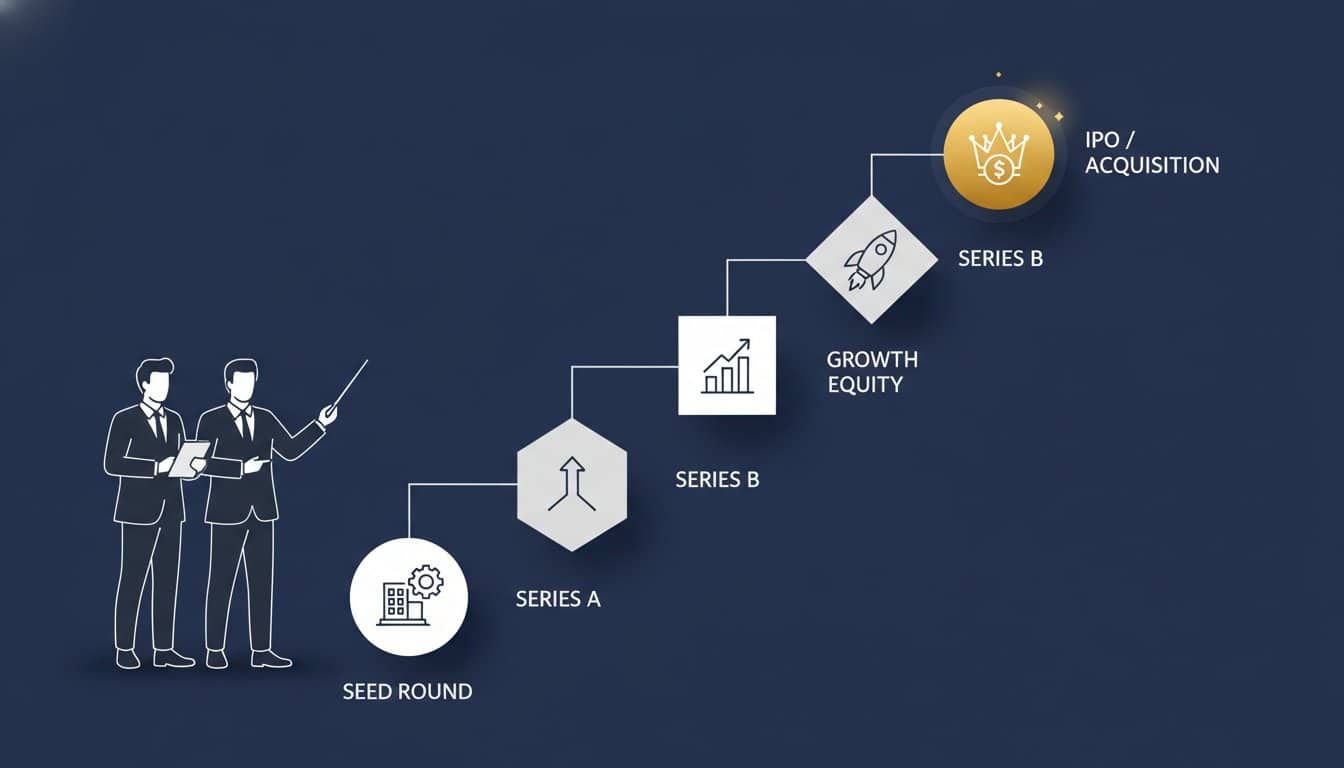
The phases of a funding round: from idea to growth
Pre-Seed and Seed phase: validating the idea and building the product
Pre-Seed: EUR 50-250k, sources: friends, family, angel investors, accelerators (Y Combinator-style programs). Objective: validate idea, build MVP, secure initial customers. Seed: EUR 250k-2M, sources: seed funds, super-angels, family offices. Objective: validate product-market fit, build initial team, demonstrate growth trajectory. Italian ecosystem: P101 Ventures, United Ventures, 360 Capital Partners active in seed.
Series A: finding product-market fit and scaling
EUR 2-10M typical ticket. Sources: traditional VC funds (national and international), strategic corporate VCs. Objective: scale validated product-market fit, expand sales and marketing, build operational infrastructure. Pre-money valuation typically EUR 8-25M for Italian Series A startups. Pattern: Series A success rate from Seed: 30-40% of seed-funded startups reach Series A.
Series B, C and beyond: expansion and market conquest
Series B: EUR 10-30M, accelerates market penetration, international expansion, product line extension. Series C+: EUR 30M+, prepares for exit (IPO or strategic acquisition), market leadership consolidation. Italian Series B/C tickets typically smaller than US/UK equivalents; international investors often required for larger rounds.
Strategic preparation: fundamental documents and metrics
Business plan and financial model
Business plan: market analysis, competitive positioning, business model, growth strategy, team, financial projections 3-5 years. Financial model: monthly granularity year 1, quarterly year 2-3, annual year 4-5. Key metrics: revenue growth, gross margin, customer acquisition cost (CAC), lifetime value (LTV), payback period, burn rate, runway. Pattern: model with sensitivity analysis on key drivers signals analytical rigour.
Cap table and due diligence documentation
Cap table: complete shareholder structure with vesting schedules, option pool, convertible instruments. Critical: clean cap table essential — complex structures with multiple founder classes, family member shareholders, or undocumented promises destroy investor interest. DD documentation: corporate governance documents, IP assignments, employment contracts, customer contracts, regulatory authorisations. Pattern: 80% of failed rounds attributed to DD findings rather than business fundamentals.
Pre-money valuation: how to determine your company’s value
Valuation methods for startups and innovative SMEs
Startup valuation challenges traditional methods: no historical earnings, future cash flows highly uncertain, comparables limited. Approaches: (a) VC method — work backwards from expected exit valuation, target IRR, expected dilution, (b) Comparable transactions — recent funding rounds in similar sector/stage, (c) Berkus method — qualitative scoring of risk factors with allocated valuation, (d) Scorecard method — comparison vs sector averages with weighted adjustments. Pattern: triangulation of methods provides realistic range.
Negotiating valuation and term sheet
Valuation negotiation balances founder dilution and investor risk-return. Common dynamics: founder wants higher valuation (less dilution), investor wants lower valuation (more upside). Sweet spot: valuation that motivates founder commitment while providing investor adequate return. Term sheet critical clauses beyond valuation: (1) Liquidation preferences — 1x non-participating standard, beware multiple/participating variants, (2) Anti-dilution — weighted average vs full ratchet, (3) Board composition — investor seats balance founder protection, (4) Vesting — founder vesting typically 4-year with 1-year cliff, (5) Drag-along/tag-along — exit dynamics protection.
Choosing the right investors: the value of “Smart Money”
Business Angel vs Venture Capital: who to choose and when
Business Angel: individual investor, EUR 25-250k tickets, often sector expert with operational experience. Useful pre-seed/seed. Advantage: faster decision, hands-on guidance. Limitation: limited follow-on capacity. Venture Capital: institutional investor, EUR 1M+ tickets, structured DD and governance. Useful Series A+. Advantage: follow-on capacity, professional network, structured guidance. Pattern: many successful startups combine angels (early) and VC (scale).
Italian funding ecosystem 2024-2025
Italian funding ecosystem in expansion phase: AIFI documents EUR 1.5-2.5B annual deployment. Growth segments: deeptech, climate tech, fintech, healthtech. Active investors: P101, United Ventures, 360 Capital, Indaco Venture Partners, CDP Venture Capital (state-backed). International funds investing in Italy: Atomico, Index Ventures, Earlybird, Lakestar. CVC active: Enel X Ventures, Generali Investments, Eni Next.
The advisor’s role in raising rounds
For founders raising rounds: advisor structures pitch deck and business plan, maps investor universe aligned to thesis and stage, manages outreach process, negotiates term sheet on critical clauses. Result: 2-4x amount raised vs autonomous attempt + governance terms more favourable to founder. Typical fee: retainer EUR 5-10k + success fee 3-7% of raised amount.
Frequently asked questions
How long does a funding round take to close?
4-9 months from launch to closing: 1-2 months preparation, 2-4 months investor outreach and negotiation, 1-2 months due diligence and legal closing. Compression below 4 months typically signals weak process or limited investor interest.
What is the typical equity dilution per round?
Pattern: 15-25% dilution per round in healthy startup. Seed round 20-25%, Series A 15-20%, Series B+ 10-15%. Cumulative dilution after 3 rounds: founders typically own 35-50% post-Series B.
Should I raise as much as possible or just what I need?
Sweet spot: raise enough for 18-24 months runway plus achievement of milestones supporting next valuation step-up. Raising too little forces premature next round at unfavourable terms. Raising too much creates excessive dilution and pressure for spending.
What is “Smart Money” and why does it matter?
“Smart Money”: investor who brings beyond capital — strategic guidance, network access, operational expertise, future round support. Pattern: smart investor adds 10-20% to startup success probability through portfolio support. Choose investors with sector expertise and track record of portfolio company support.
Can I refuse a funding offer?
Yes, and sometimes should. Right reasons to refuse: misaligned values, problematic term sheet clauses (multiple liquidation preferences, full ratchet anti-dilution), insufficient investor commitment or follow-on capacity, conflict with existing investors. Wrong reasons: holding out for marginally better valuation when offer is fundamentally acceptable.
Raising a funding round?
30-minute discovery call to assess your readiness and discuss optimal fundraising strategy for your stage. Confidential conversation →