

Updated on
The Lehman Scale is the dominant fee model for boutique and mid-market M&A advisors. It calculates the success fee on Enterprise Value in a decreasing manner: higher percentage on the first millions, progressively lower. This calculator shows in real time how much you would pay in success fee to your advisor depending on the chosen Lehman structure. Understanding the lehman scale calculator fee is essential for accurate financial planning. Using the lehman scale calculator fee can help in making informed decisions.
Lehman Scale Calculator
How the Lehman Scale works
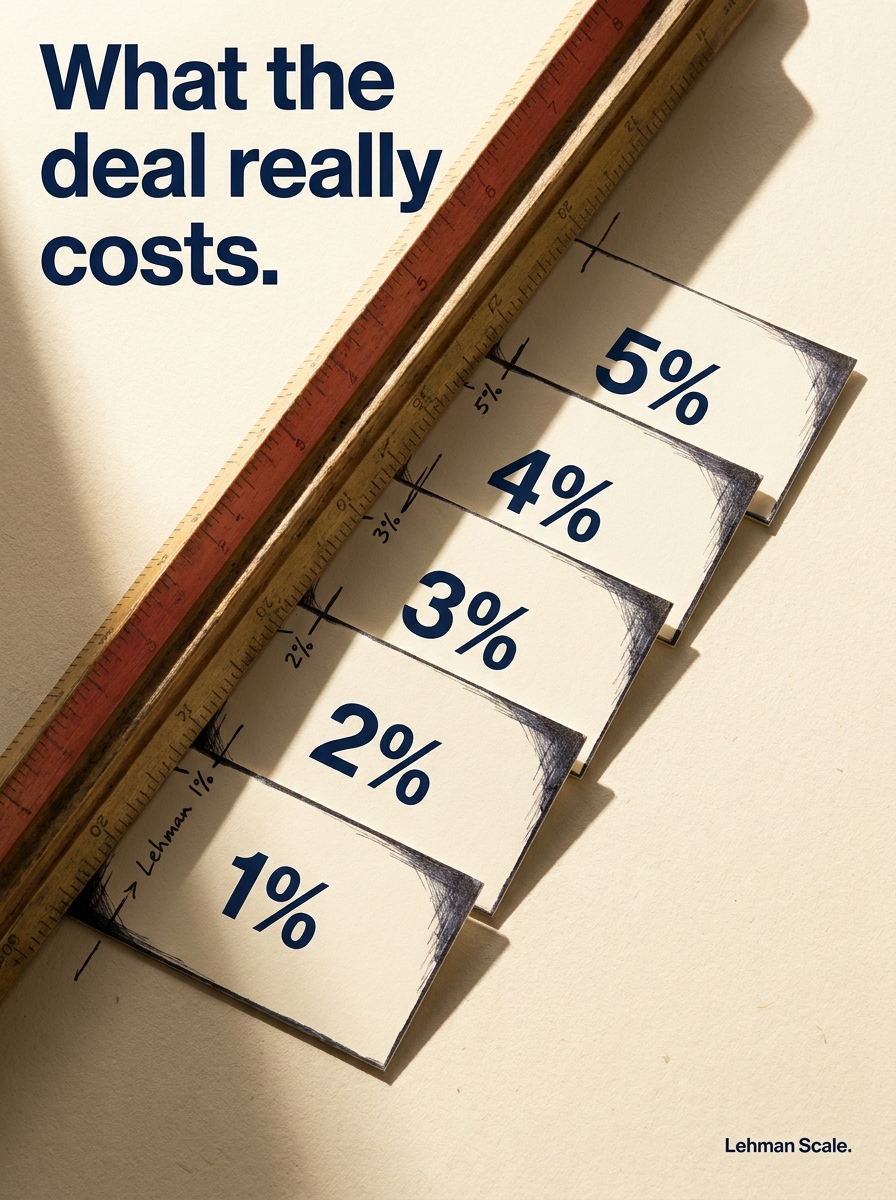
The model is “decreasing by tier”: you pay a higher percentage on the first millions of the deal, lower on the following ones. “Classic” example (5-4-3-2-1) on a EUR 25M deal:
| Tier | EV in this tier | % | Tier fee |
|---|---|---|---|
| First million | EUR 1M | 5% | EUR 50,000 |
| Second million | EUR 1M | 4% | EUR 40,000 |
| Third million | EUR 1M | 3% | EUR 30,000 |
| Fourth million | EUR 1M | 2% | EUR 20,000 |
| Above 4M (on 21M) | EUR 21M | 1% | EUR 210,000 |
| Total | EUR 25M | − | EUR 350,000 |
Effective rate: 1.40% on the total deal.
The 3 types of Lehman scale
Classic Lehman (5-4-3-2-1)
Historical standard, today rarely used as perceived as obsolete. Effective rate too low for deals above EUR 50M.
Modern / Double Lehman (10-8-6-4-2)
Dominant pattern in mid-market 2020-2025. Doubles the Classic but remains decreasing. Balanced for deals EUR 10-50M EV.
Boutique mid-market (5-4-3-2-1.5)
Variant that keeps a higher “floor” on large deals (1.5% instead of 1%). Emerging pattern for senior Italian boutiques handling complex deals.
Typical 2024-2025 ranges
| Deal EV | Typical effective rate | Market pattern |
|---|---|---|
| EUR 5-10M | 3-5% | Small-cap boutique |
| EUR 10-30M | 2-3.5% | Pure mid-market, Modern Lehman dominant |
| EUR 30-100M | 1.5-2.5% | Upper mid-market, boutique or investment bank |
| EUR 100-500M | 1-1.8% | Bulge bracket or mid-cap I-banks |
| EUR 500M+ | 0.5-1.2% | Pure bulge bracket |
Frequently Asked Questions
Can I negotiate a fee structure different from Lehman?
Yes. Common alternatives: flat fee + success cap (predictability for complex deals), tiered fee with incentive above target price, equity-aligned fee (advisor becomes deal partner). Pattern: discuss openly with the advisor — if they are competent, they can adapt to your specific situation.
Is the retainer “credited” against the success fee or additional?
Dominant pattern: the retainer is credited against the success fee (retainer paid during the deal is “credited” at closing, final success fee = success fee − retainer paid). Less favourable variant for the Seller: additional retainer. Negotiate clearly in the mandate letter.
What happens if the deal does not close?
Typically: retainer is not refunded (compensates the work done); success fee not owed. Exception: “tail” clause — if the deal closes within 12-24 months post-mandate with a buyer already introduced by the advisor, the success fee is owed anyway.
Do fees include third-party costs (legal, due diligence)?
No, they are additional. Pattern: seller-side legal 0.5-1.5% of price; due diligence accountant EUR 50-150k; appraisers if needed EUR 15-40k. Total third-party costs typically: 1.5-3.5% of deal price, on top of the advisor fee.
Is the advisor fee taxable income for the seller?
For the seller (advisor client), the fee is a deductible cost against capital gain — reducing taxable base. For the advisor, it is of course income taxed as business income.
Can I pay the fee in equity instead of cash?
Yes, “equity-aligned” pattern. Advantage: zero cash outflow at closing, advisor becomes an aligned partner. Typical pattern: 30-50% of success fee in equity of the sold company or post-deal NewCo. Consider governance and tax implications.
Negotiating a fee with an advisor?
30-minute discovery call to apply the calculator to your deal, evaluate 2-3 alternative structures, identify realistic negotiation levers. Advisor fee analysis →