

Updated on
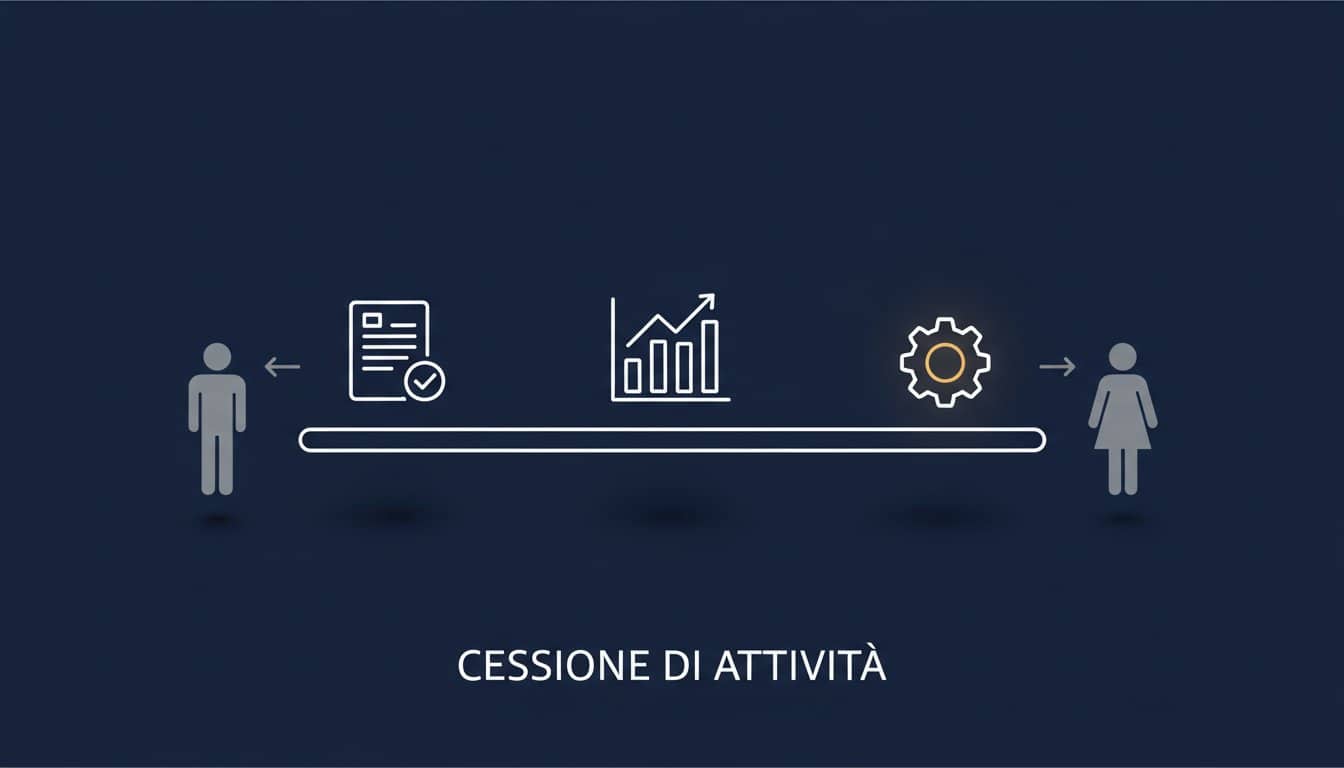
The sale of a commercial business (cessione di attività commerciale, also known as “going-concern sale” or “asset deal”) is a specific Italian legal-tax category for selling a business as a operational entity rather than through share transfer. Distinct from a corporate share sale, this operation transfers the operational complex (assets, contracts, customer relationships, employees, goodwill) under specific Italian Civil Code provisions. This guide focuses on the legal and tax aspects of commercial activity sale: process, contractual elements, taxation, strategic clauses.
Key takeaways
- Sale of commercial activity is the going-concern asset deal: transfers operational business as integrated complex rather than through share transfer.
- Distinct from share deal (sale of company shares): different tax treatment, different legal framework, different operational complexity.
- Italian Civil Code provides specific framework (art. 2555 et seq.) governing transfer of commercial activity.
- Tax treatment: capital gain on assets less favourable than share-deal PEX for Italian corporate sellers; advantageous for individual sellers in specific situations.
- Key contractual elements: detailed transferred-assets list, employee transfer per art. 2112 Civil Code, supplier/customer contracts novation, goodwill valuation.
Sale of Activity vs Sale of Shares: structural differences
What is transferred?
In activity sale: operational complex transfers (specific assets, inventory, equipment, contracts, customer relationships, goodwill, employees), while seller’s legal entity (company) remains owned by seller post-transfer. In share sale: shares of legal entity transfer to buyer; underlying business (and all assets/liabilities including unknown) follows shares to buyer.
Comparative analysis: pros and cons
| Aspect | Activity sale | Share sale |
|---|---|---|
| Tax (corporate seller) | Capital gain taxed normally | PEX regime: 95% tax-exempt if qualifying |
| Tax (individual seller) | Variable, depends on holding period and structure | Standard capital gain |
| Liability transfer | Selective per asset | All liabilities including unknown |
| Operational complexity | Higher (asset-by-asset transfer) | Lower (single share transfer) |
| Tax for buyer | Asset step-up: depreciable goodwill | No step-up, goodwill capitalised |
| Italian mid-market frequency | ~20% | ~80% |
Legal and bureaucratic process of activity sale
Preliminary phase: Letter of Intent and Due Diligence
Non-binding LOI defines preliminary terms (price, payment structure, conditions). Comprehensive DD: legal (transferable contracts, IP, regulatory authorisations), financial (P&L allocation, asset valuation), tax (capital gain calculation, indirect tax exposure), labour (employee categorisation, art. 2112 transfer mechanics). Duration: 2-3 months for mid-market commercial activity.
Contract execution: notarial deed and essential contents
Italian law requires notarial public deed (atto pubblico) for activity sale. Essential contents: detailed list of transferred assets, excluded items, valuation of goodwill (avviamento), customer list, supplier contracts identified for novation, employee list with art. 2112 transfer mechanism, payment terms, representations and warranties, indemnification, non-compete clauses (art. 2557 Civil Code).
Subsequent fulfilment and handover
Post-signing administrative steps: notification to suppliers and customers (for contract novation), employee notification per art. 2112, regulatory authorisations transfer (where required), tax registrations updates, commercial registry updates, banking relationships transfer. Pattern: smooth handover requires 30-90 days post-signing.
Taxation of the sale: managing capital gains and indirect taxes
Capital gain calculation
Capital gain = sale price − tax basis of transferred assets. Tax basis: book value of transferred assets adjusted for accumulated depreciation, indexation where allowed. For Italian corporate seller: full capital gain taxed at IRES (currently 24%); the gain is excluded from the IRAP base. For individual seller: variable treatment depending on professional vs occasional activity, holding period.
Tax regimes for the seller
Optimisation options: (a) Ordinary regime: capital gain in single tax year, (b) Tax allocation: gain spread over multiple years (typically 5) for individual sellers meeting requirements, (c) Substitute taxation: in specific cases, single substitute tax replaces ordinary IRPEF (currently 26% for individual sellers). Best regime depends on seller’s specific position; tax planning before sale signing essential.
Indirect taxes: registry, VAT, mortgage and cadastral
Activity sale not subject to VAT (out of scope per art. 2 DPR 633/72). Registry tax applies: 3% on movable assets (with exceptions), 9% on real estate component, plus mortgage and cadastral taxes if real estate involved. Critical: tax planning on asset allocation between movable/real estate impacts total indirect tax burden.
Strategic contractual clauses
- Non-compete clause (art. 2557 Civil Code): seller cannot compete in same market for up to 5 years
- Employee transfer: art. 2112 governs automatic transfer with continued employment terms
- Contracts novation: customer/supplier contracts require third-party consent for transfer
- Representations and warranties: typical mid-market includes operational warranties, financial accuracy, tax compliance, legal compliance
- Indemnification: cap, threshold, time limits negotiated
- Escrow: typical 5-15% of price held for 18-24 months
The role of advisor and legal counsel
Activity sale requires more legal complexity than share deal. Advisor team: senior M&A advisor (transaction structuring, buyer negotiation), specialised legal counsel (Italian Civil Code application, contract novation, employee transfer), tax advisor (capital gain optimisation, indirect tax planning), notary (public deed execution). Total professional cost: 2-4% of deal value (higher than share deal due to legal complexity).
Frequently asked questions
When does activity sale make more sense than share sale?
Three scenarios: (a) selling individual seller benefiting from specific tax regime, (b) buyer wanting selective asset acquisition without legacy liabilities, (c) regulatory or contractual reasons prevent share transfer (e.g. owner-specific authorisations not transferable through share deal).
How are employees affected by activity sale?
Italian Civil Code art. 2112: employees automatically transfer to buyer with continued employment terms, accrued benefits preserved, no termination required. Union consultation often required for significant operations. Pattern: smooth employee transition critical for operational continuity.
What happens to outstanding contracts in activity sale?
Most contracts require third-party consent for transfer (novation). Some contracts transfer automatically per Italian Civil Code provisions. Critical: identify which contracts require novation during DD; plan systematic novation process.
How is goodwill valued in activity sale?
Goodwill (avviamento) calculated as difference between total purchase price and fair value of net transferred assets. Specific valuation may use earning capacity methods, customer relationship valuation, or residual approach. Tax treatment: depreciable for buyer over 18 years; capital gain for seller.
Can I retain some assets in activity sale?
Yes. Activity sale allows selective inclusion: specify in detailed contractual list what’s transferred and what’s excluded. Common exclusions: real estate (retained or transferred to separate vehicle), specific contracts, related-party receivables. Customisation flexibility distinguishes activity sale from share sale.
Planning a sale of commercial activity?
30-minute discovery call to discuss your specific case and optimal share-vs-activity structuring. Confidential conversation →