

Updated on
For an Italian entrepreneur deciding to sell, the question “asset deal or share deal?” — sale of business (going-concern asset) versus sale of shares — determines tax burden, legal complexity, operational continuity, and ultimately net cash received. The wrong choice can cost 15-30% of after-tax proceeds. This guide outlines the key differences from the entrepreneur’s perspective: tax treatment, legal framework, operational implications, and how to choose between the two structures.
Key takeaways
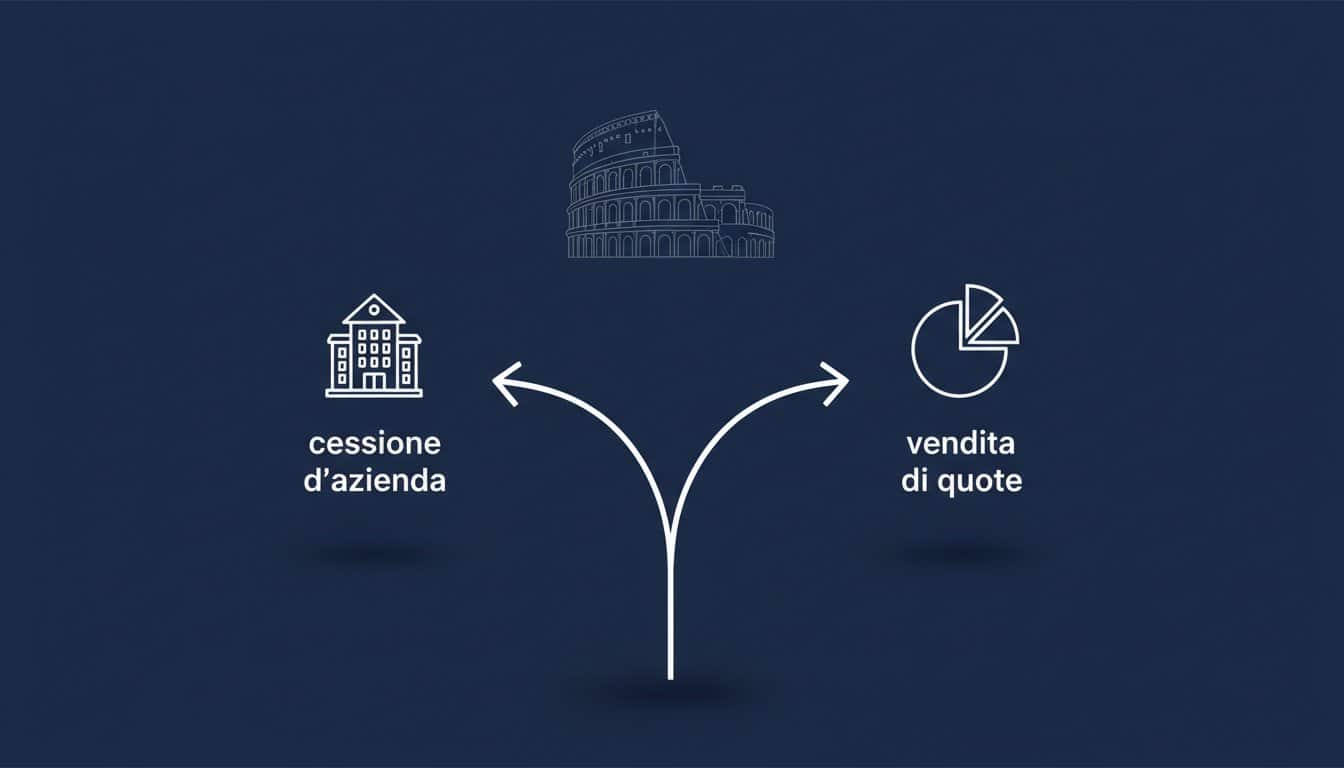
- Share deal (vendita di quote): seller transfers ownership of legal entity to buyer; everything follows shares including unknown liabilities.
- Asset deal (cessione d’azienda): seller transfers operational business as integrated complex; legal entity remains with seller post-transfer.
- Tax treatment fundamentally different: share deal favourable for Italian corporate sellers (PEX regime), asset deal sometimes preferable for individual sellers or buyers needing step-up.
- Operational implications: share deal simpler (single share transfer), asset deal more complex (asset-by-asset transfer with contracts novation).
- Italian mid-market preference: ~80% share deals, ~20% asset deals, depending on specific seller/buyer tax positions.
The two structures explained
Sale of shares (vendita di quote)
Seller transfers ownership of legal entity (shares or quotas) to buyer. Everything that legal entity owns (operations, assets, contracts, liabilities including unknown) follows shares to new owner. Single legal act: share transfer agreement. Simplicity advantage: most operations preserved automatically (employee contracts, supplier agreements, customer relationships, regulatory authorisations).
Sale of business / commercial activity (cessione d’azienda)
Seller transfers operational business as integrated complex (specific assets, inventory, equipment, identified contracts, goodwill, employees per art. 2112), while seller’s legal entity remains in seller’s ownership post-transfer. Complex legal act: detailed transfer agreement, public notarial deed, contracts novation per asset, regulatory authorisations re-transfer.
Tax comparison: the decisive factor
Italian corporate seller (typical mid-market scenario)
Share deal: PEX (Participation Exemption) regime if qualifying — 95% of capital gain tax-exempt for Italian corporate seller. Conditions: 5%+ ownership, held 12+ months, in operational company. Effective tax: typically 1.2% (24% IRES × 5% taxable portion). Asset deal: capital gain on assets taxed at IRES only (24%); the gain is excluded from the IRAP base.
For Italian corporate seller meeting PEX requirements: share deal generates 26+ percentage points lower tax than asset deal. On EUR 10M capital gain: share deal saves EUR 2.6M in taxes. This explains why share deal dominates Italian mid-market.
Individual seller (founder-owned)
Less clear-cut. Share deal: capital gain taxed at 26% (currently). Asset deal: variable depending on activity classification, holding period, allocation options. In specific cases, asset deal can be tax-advantageous for individual seller (e.g. small business owner with specific tax allowances). Pattern: tax planning critical, advisor consultation 6-12 months before sale recommended.
Buyer’s tax perspective
Share deal: buyer assumes shares at agreed price; no step-up on underlying assets. Goodwill capitalised but not depreciable from share-deal goodwill. Asset deal: buyer steps up assets to fair value, depreciable goodwill (typically 18 years), better tax shield in early ownership years. Pattern: buyer’s tax position may motivate paying more for asset deal vs share deal — but rarely enough to overcome seller’s preference for share deal in PEX scenarios.
Legal framework: complexity comparison
Share deal complexity
- Single agreement: Share Purchase Agreement (SPA)
- Legal due diligence focuses on corporate matters, capital structure, governance
- Single signing event for ownership transfer
- Operational continuity preserved automatically
- Regulatory authorisations typically preserved (change of control may require notification)
Asset deal complexity
- Multiple agreements: transfer agreement + supplier novations + customer novations + employee transfer documentation
- Legal due diligence covers each asset and contract separately
- Notarial public deed required (atto pubblico)
- Contracts novation requires third-party consent (typically 3-9 months)
- Regulatory authorisations require re-transfer or re-application
- Employee transfer per art. 2112 with union consultation if significant
Operational implications
Employee transfer
Share deal: no change for employees — same employer (the company) under new ownership. Asset deal: art. 2112 governs automatic transfer with continued employment terms and accrued benefits preserved. Union consultation often required for significant operations.
Customer and supplier continuity
Share deal: contracts remain with company under new ownership; minimal customer/supplier disruption. Asset deal: contracts require novation with third-party consent; risk of customer/supplier defection during transition.
Brand and goodwill
Share deal: brand and goodwill follow shares automatically. Asset deal: brand and goodwill explicitly transferred; specific valuation in deed; depreciable for buyer over 18 years.
The strategic choice for the Italian entrepreneur
Choose share deal when:
- Italian corporate seller benefiting from PEX regime
- Operational continuity important (customer relationships, regulatory authorisations)
- Buyer willing to assume operational complexity (typical strategic and PE buyers)
- Timeline acceleration needed (simpler legal process)
Choose asset deal when:
- Individual seller benefiting from specific tax allowances
- Buyer requires step-up on assets for tax shield (typically PE with significant leverage)
- Seller wants to retain specific assets (selective transfer)
- Existing legal entity has hidden liabilities buyer wants to avoid
- Regulatory or contractual barriers to share transfer
The advisor’s role in structuring choice
Pre-process structural analysis: advisor evaluates seller’s tax position, buyer profile, operational implications, regulatory factors. Output: recommended structure (share or asset deal) with quantified after-tax outcome for each option. Typical analysis: 2-3 weeks, EUR 10-25k cost, but can save EUR 0.5-3M in after-tax proceeds through optimal structuring.
Frequently asked questions
Can I switch between share deal and asset deal during negotiation?
Yes, but requires renegotiation of terms. Pattern: preferred structure agreed in Letter of Intent; significant change during negotiation often signals deal instability. Best practice: structural analysis before LOI signing.
How long does each structure take to complete?
Share deal: 3-6 months from LOI to closing typically. Asset deal: 6-12 months due to legal complexity (notarial deed, contracts novation, employee consultation). Plan timing accordingly.
Are professional fees different?
Yes. Share deal total professional cost: 1.5-3% of deal value. Asset deal: 2-4% (higher due to legal complexity, notarial requirements, contracts novation). Differential of EUR 50-200k typical on mid-market deal.
What about real estate owned by the company?
Share deal: real estate stays with company (shares transferred). Asset deal: real estate either transferred separately (subject to higher registry tax 9% + mortgage/cadastral) or retained by seller for separate use. Common pattern in asset deals: real estate transferred to seller’s separate vehicle, then leased to buyer.
What if I want to keep some operations and sell others?
Asset deal optimal: selective inclusion through detailed contractual specification. Share deal doesn’t allow selectivity (entire company transfers). For selective sale, asset deal or carve-out structure required.
Need help structuring your sale?
30-minute discovery call to evaluate share vs asset deal optimal structure for your specific situation. Confidential conversation →