Updated on
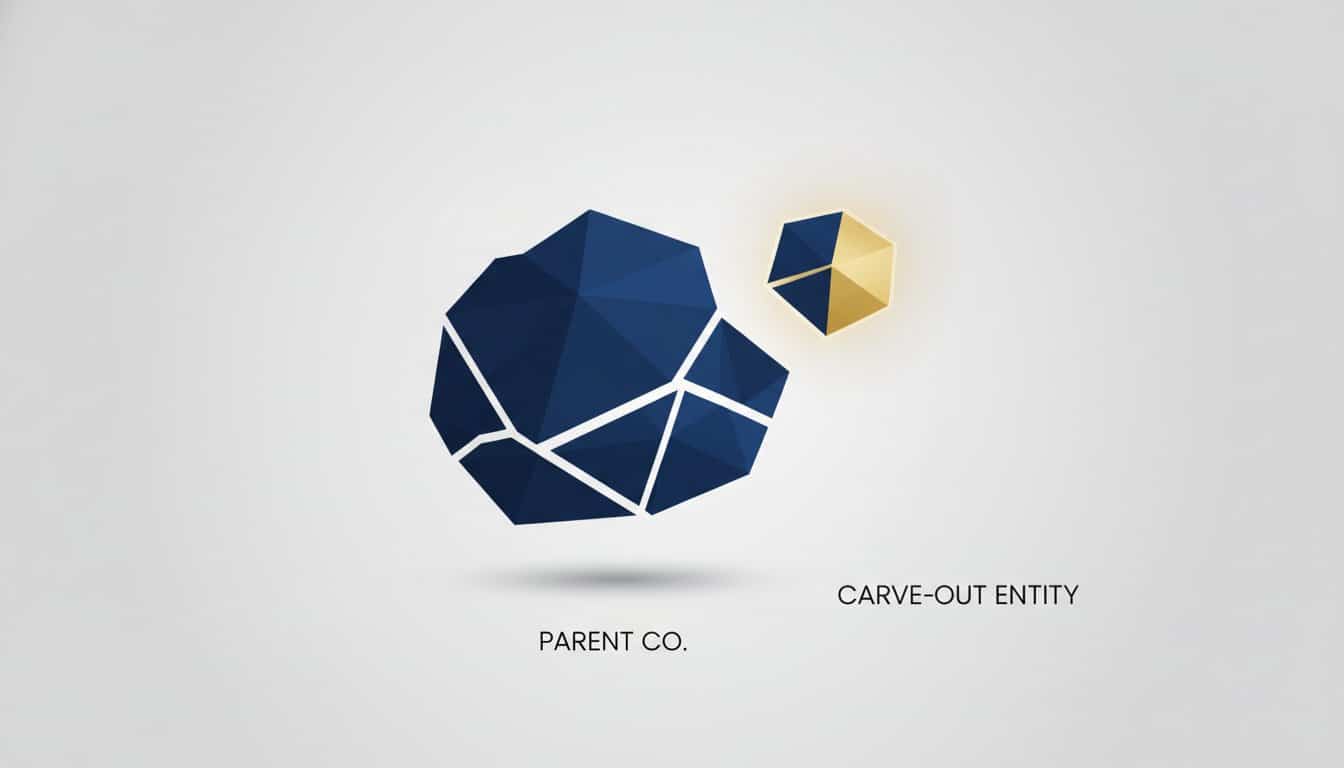
A Carve-Out is the strategic operation by which a company separates and sells a business unit or division, allowing the parent to focus on the core while monetising non-strategic assets. Unlike a complete company sale, the carve-out requires structural separation of the divested business — operationally, financially, contractually. This guide explains the operational framework: definition, strategic drivers, process phases, challenges of separation.
Key takeaways
- Carve-out separates a business unit from a parent company and sells it to external buyer, distinct from spin-off (creates separate listed entity) and from outright sale of entire company.
- Strategic drivers: core business focus, capital generation, regulatory/antitrust compliance, value creation through buyer-specific synergies.
- Four-phase process: strategic analysis, preparation and DD, structuring and execution, separation and post-closing.
- Carve-out complexity often underestimated: separation of shared services, IT systems, customer contracts, employee transfers requires 6-18 months.
- Italian mid-market: carve-out common in family-business diversified groups simplifying for succession; growing pattern in M&A activity 2022-2025.
What is a Carve-Out? Strategic definition and meaning
Carve-Out vs Spin-Off: key differences
Carve-Out: business unit separated and sold to external buyer (private or strategic). Parent receives cash; divested business becomes part of buyer’s organisation. Spin-Off: business unit separated and distributed as separate listed company to parent’s shareholders. No cash to parent; shareholders receive shares in new entity. Pattern: carve-out is monetisation operation; spin-off is structural re-organisation. Italian mid-market: carve-out far more common than spin-off due to limited public market activity.
Why Carve-Out is more than a simple sale
Carve-out complexity exceeds standard M&A in three dimensions: (a) Operational separation — divested business often shares services with parent (HR, IT, finance, legal) requiring disentanglement, (b) Contractual separation — customer/supplier contracts may be at parent-group level requiring novation, (c) Financial separation — historical financials may not exist on standalone basis, requiring construction of “carve-out financials” for buyer evaluation.
When and why execute a Carve-Out? Strategic drivers
Core business focus and simplification
Most common driver: parent decides to focus resources on core business and divest non-core operations. Drivers: strategic refocus, capital reallocation, management attention concentration. Pattern: diversified Italian mid-market groups often have 2-3 unrelated business units; carve-out of non-core releases management capacity for core acceleration.
Liquidity generation and asset valorisation
Carve-out generates cash for parent without diluting core ownership. Capital uses: debt reduction, dividend distribution, core business reinvestment, acquisition financing. Pattern: divested non-core often achieves higher multiples with specialised buyers than embedded in diversified parent — value-creation gap of 20-40% common.
Regulatory or antitrust resolution
Sometimes carve-out mandated: antitrust authorities require divestiture for M&A approval, regulatory changes affect business unit viability, strategic compliance requirements. Pattern: forced carve-outs typically achieve lower valuations than voluntary (less time for preparation, weaker negotiation position).
Key phases of a Carve-Out operation: integrated process
Phase 1: strategic analysis and planning
2-4 months. Strategic rationale articulation, perimeter definition (what’s in/out of carve-out), preliminary financial separation (historical financials reconstruction on standalone basis), value-creation analysis (standalone valuation, buyer universe assessment), management decision framework, board approval.
Phase 2: preparation and Due Diligence
3-6 months. Detailed carve-out financials preparation, transition services analysis (what services parent will provide during transition), legal separation analysis (contracts, IP, regulatory authorisations), HR transition planning (employee categorisation, transfer mechanisms), IT systems separation analysis, Vendor Due Diligence preparation (for streamlined buyer-side DD).
Phase 3: structuring and sale execution
4-6 months. Buyer outreach (strategic, financial, hybrid), confidential information memorandum distribution, beauty contest with 5-10 active bidders, due diligence support, SPA negotiation including transition services agreement (TSA), regulatory approvals, closing preparation.
Phase 4: separation and post-closing
6-12 months post-closing. Operational separation execution (shared services migration, IT systems separation, contract novation), employee transition, TSA support during transition period, parent’s residual organisational adjustment, divested business integration with buyer.
Carve-out challenges and risks
- Historical financials reconstruction: standalone P&L often requires significant adjustment from segment reporting
- Shared services costs: identifying true cost of services historically provided by parent at internal pricing
- Customer/supplier consent: contract novation may require third-party consents
- Key talent retention: divested unit’s key employees may resist transfer or use opportunity to demand retention packages
- IT systems separation: integrated systems complex to separate, often requiring temporary parallel operation
- Brand transition: if divested unit shares parent brand, transition to new identity required
- TSA management: transition services agreement requires careful structuring to ensure smooth separation
The advisor’s role in Carve-Out
Senior M&A advisor specialised in carve-out brings: structural separation expertise (financial, operational, legal), buyer universe mapping (strategic and financial buyers with carve-out experience), TSA structuring expertise, integrated coordination of legal, tax, HR, IT workstreams. Pattern: carve-out advisor fee 2-3% of deal value (higher than standard M&A due to additional complexity); typical mid-market carve-out: total professional cost EUR 800k-2M.
Frequently asked questions
What is the difference between Carve-Out and divestment?
Divestment is general term for selling non-core asset. Carve-out is structured divestment of operational business unit requiring separation. Asset divestments (selling individual assets) simpler than operating business divestments (carve-out).
How long does a complete Carve-Out process take?
12-24 months from strategic decision to operational separation completion. Sale process itself 6-12 months; pre-sale preparation 3-6 months; post-closing separation 6-12 months. Total complexity exceeds standard M&A.
What types of buyers acquire carved-out businesses?
Three categories: (a) strategic buyers (industrial groups acquiring complementary business), (b) PE funds (specialising in carve-out value creation), (c) management with PE backing (MBO of carved-out unit). Each typology requires different structuring and negotiation approach.
What is a TSA (Transition Services Agreement)?
Contractual agreement under which seller provides services (IT, HR, finance, etc.) to divested business during transition period (typically 6-18 months). Critical for operational continuity. Pricing typically at cost-plus or pre-agreed rates.
Can Carve-Out be done for non-controlling minority stakes?
Yes, common pattern: parent retains 20-40% minority while selling controlling stake. Provides upside participation, signals confidence to buyer, smooths transition. Requires shareholder agreement governing post-carve-out dynamics.
Considering a Carve-Out?
30-minute discovery call to discuss your specific carve-out scenario and assess strategic feasibility. Confidential conversation →