Updated on
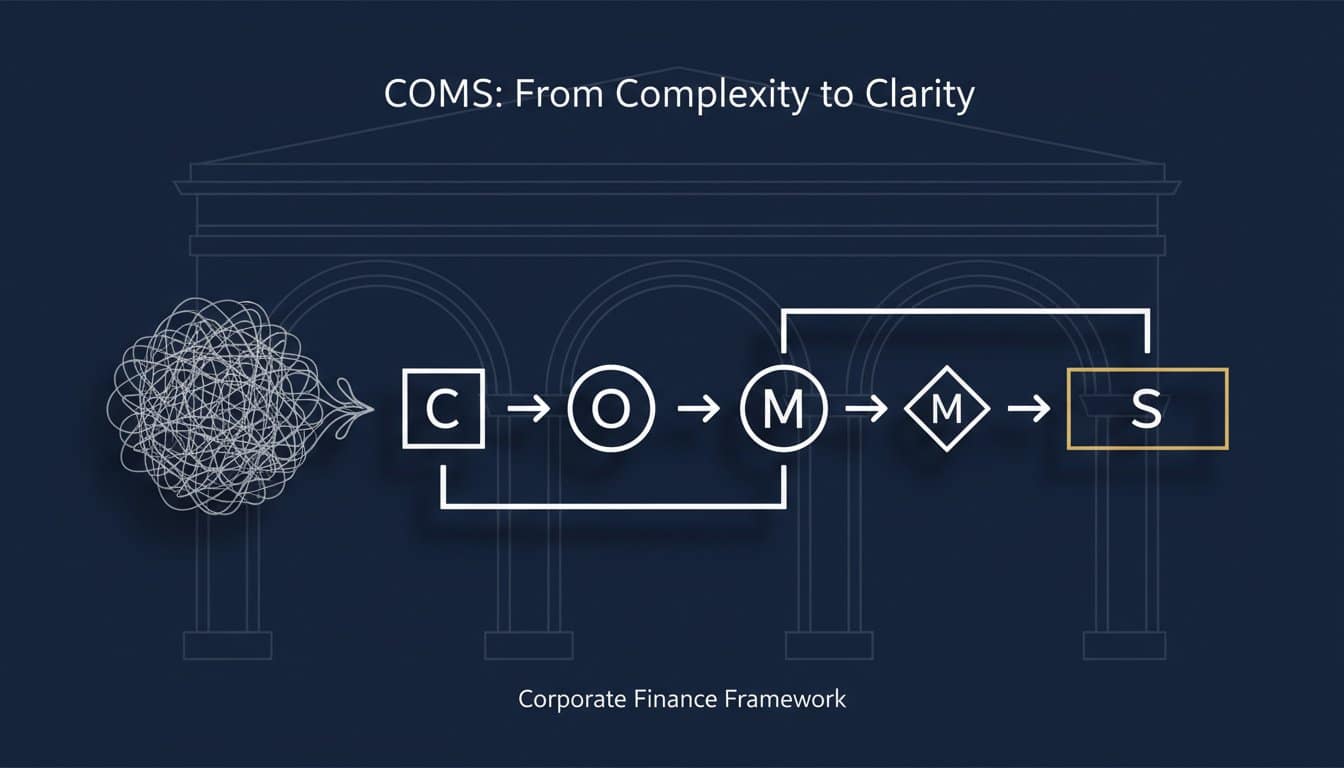
For an Italian entrepreneur facing an extraordinary operation — sale, acquisition, restructuring, capital raising, generational transition — methodology is the determining variable between success and value destruction. The COMS framework (Consulting, Mandate, Operations, Straordinary) is a structured approach for guiding extraordinary corporate finance operations from strategic phase to execution. This guide explains its logic, phases, application scenarios, and the criteria to identify an advisor who really applies it.
Key takeaways
- Ordinary business management is not enough during extraordinary operations: discontinuity requires specific methodology with explicit codification of phases.
- The COMS framework structures four sequential phases: Consulting (strategic analysis), Mandate (formalisation of objectives), Operations (execution with continuous discipline), Straordinary (specific management of extraordinary discontinuity).
- Application scenarios: M&A buy-side and sell-side, corporate turnaround, generational transition, capital opening, debt restructuring.
- Advisor selection: structural independence, verifiable specific track record, codified methodology rather than reliance on personal reputation alone.
- Result: deals closed at full value, integration succeeding, identity continuity preserved across the transition.
Decoding COMS: beyond the acronym, a strategic approach
Why ordinary management is not sufficient
Extraordinary operations differ from routine in four dimensions: irreversibility (the decision reshapes the company permanently), complexity (multiple interconnected workstreams), pressure of time (closing windows of weeks rather than months), identity dimension (the founder is not selling an asset, they are passing on a story). Standard managerial tools — Gantt charts, KPI dashboards, monthly cadence — are insufficient. They cover the “what” without addressing the “why” or the irreversibility risk.
The four key letters of the COMS framework
- C — Consulting: strategic analysis of the operation in its broader context, identifying objectives, constraints, success drivers, and risk factors beyond the conventional financial frame.
- M — Mandate: explicit formalisation of mutual objectives between client and advisor, with clear engagement scope, deliverables, timeline, and shared definition of success.
- O — Operations: structured execution with continuous discipline, integration of multiple workstreams (legal, financial, operational, communications), real-time risk management.
- S — Straordinary: specific management of the discontinuity dimension — what makes the operation different from routine, the irreversibility factor, the post-operation organisational impact.
The phases of the COMS framework: from strategy to execution
The Consulting (C) phase and the Mandate (M)
The first two phases — frequently undervalued by less methodical advisors — are where the foundation of value is built. Consulting requires deep analysis of the client’s specific situation: not “we usually do this”, but “what does your specific case demand”. The Mandate phase formalises shared expectations: what will be done, what will NOT be done, how success is measured, who decides what. Pattern: an explicit mandate of 5-7 pages prevents 80% of midstream misunderstandings.
The Operations (O) phase and managing the Straordinary (S)
Operational execution requires continuous discipline: weekly tracking with explicit risk register, escalation protocols for cross-workstream issues, structured communication with all stakeholders. The Straordinary dimension is what differentiates COMS from a standard project management approach: explicit handling of identity preservation, organisational impact post-deal, integration of multiple interest holders (family members, key managers, employees, suppliers).
When to apply the COMS method: concrete scenarios
COMS in M&A and company sale operations
For a sale, COMS structures the four phases around the specific timeline: Consulting (2-3 months of preparation, including data room, valuation, buyer mapping), Mandate (signed engagement with explicit scope and success metrics), Operations (beauty contest, negotiation, SPA), Straordinary (managing the founder’s identity transition, post-closing integration support). Result: deals closed at 25-40% higher value vs bilateral negotiation, with founder identity preserved through the transition.
COMS in crisis and turnaround management
For a corporate turnaround, COMS adapts to the urgency: Consulting compressed to 4-6 weeks of intensive diagnosis (financial, operational, market), Mandate including pre-defined escalation paths, Operations with weekly cash-flow management and tactical workstream coordination, Straordinary management of stakeholder anxiety (creditors, employees, suppliers, key clients). Pattern: turnaround managed through structured COMS framework produces successful recovery in 60-75% of cases, vs 30-40% for unstructured approaches.
Choosing the right advisor for an effective COMS approach
Essential technical competencies
Specific extraordinary finance experience: M&A closed over 5+ years, turnaround handled across multiple sectors, capital raising structures (debt, equity, mezzanine). Sector specialisation: a generalist advisor on a vertical sector destroys value compared to a specialist. Verifiable network: direct relationships with strategic buyers, PE/VC funds, debt funds active in the specific sector.
Personal qualities that make the difference
Beyond technical skills: capacity to read the human dimension of the operation (founder identity, family dynamics, organisational equilibria), discipline in maintaining methodology under pressure, independence of judgement (capacity to disagree with the client when necessary), structured communication clarity (the advisor must be able to explain complex topics simply to stakeholders not technically equipped).
The method in practice: applying COMS for the Italian mid-market
An experience-based approach
Across 80+ closed cross-border operations over 20+ years, COMS has matured as the explicit framework guiding advisory work. Each operation reveals new nuances and refines the methodology. The Italian mid-market presents specific challenges that COMS addresses: founder identity dimension stronger than in Anglo-Saxon contexts, family equilibria more relevant, supply-chain relational depth more important, regulatory uncertainty greater. COMS adapts to each scenario without losing its structural coherence.
From theory to practice: opening a dialogue
The first conversation with an advisor reveals whether COMS or equivalent codified methodology is really applied. Three questions that test the depth: “What is your specific Consulting phase for my type of operation?”, “How do you formalise the Mandate phase in writing?”, “How do you manage Straordinary discontinuity beyond standard project management?”. An advisor with method answers concretely; one without method retreats to generalities about experience and reputation.
Frequently asked questions
Is COMS applicable to small SMEs or only mid-market and beyond?
Applicable to companies above EUR 5M revenue with extraordinary operations involved. Below this threshold, simpler approaches sometimes suffice. Optimal application: companies EUR 10-200M revenue facing strategic discontinuity (sale, acquisition, restructuring, capital opening).
How does COMS differ from a standard M&A advisory framework?
The fundamental difference is the explicit Straordinary (S) dimension: managing the discontinuity factor that goes beyond the technical operation. Standard frameworks cover the “what” (process, valuation, negotiation, closing); COMS adds the “why” and the “what happens after”. Result: deals closed at full value with founder identity preserved and post-closing integration succeeding.
Can COMS be applied internally without an external advisor?
Partially. The Consulting and Mandate phases benefit from external perspective (avoids cognitive bias of internal team). The Operations phase requires either dedicated internal team (rare in mid-market) or external advisor. The Straordinary phase typically requires external mediation (independent reading of identity and organisational dynamics).
How long does a complete COMS cycle last?
Variable by operation type: M&A sell-side 6-12 months, M&A buy-side 3-9 months per target, turnaround 12-24 months, capital raising 4-9 months, generational transition 12-36 months. Each phase has its own duration: Consulting 4-8 weeks, Mandate 1-2 weeks, Operations 60-80% of total time, Straordinary integrated throughout but particularly intensive in transition phases.
What does a complete COMS-based mandate cost?
Standard mid-market structure: retainer EUR 5-15k/month + success fee 0.5-2.0% of deal value (Lehman scale structure). On EUR 25M deal: total fee approximately EUR 300-500k. Largely justified by value uplift generated through structured competitive process (typically EUR 5-10M on the final price).
Want to apply COMS to your specific operation?
30-minute discovery call to discuss your specific case — sale, acquisition, capital opening, restructuring — and assess how the COMS framework can be calibrated to your context. Confidential conversation →